Free sample chapter from FRM Level I: Financial Markets and Products II.
Chapter 1: Options Markets and the Properties of Options
Chapter 1: Options Markets and the Properties of Options
The previous course ended with a hedge that worked. Ravensmoor's $800 million Core Equity Fund, with a beta of 1.15 against the Hartwell 500, was protected by selling index futures. The hedge cost nothing up front, removed 91.84% of the fund's variance, and left exactly the residual risk the manager is paid to take.
It also removed every dollar of upside. A fund that has sold futures against its whole market exposure earns the risk-free rate whatever the market does. If the index rises 10%, the futures lose what the shares gain. The investment committee wants something different: protection against a fall, and the gains from a rise kept.
That is what an option does, and this chapter prices it. It defines the contracts, then shows how far arbitrage alone constrains their prices — without any model of how the index moves. The constraints turn out to be tight. One of them, put-call parity, says that the hedge the committee wants differs from the futures hedge it already has by exactly one call option — and so it costs exactly what that call costs.
- 4,600 Index puts to insure the fund (the same count as the futures hedge, because both are set by beta)
- $24.34M Cost of a 3,800 floor (3.04% of the fund, paid today, for six months of insurance)
- = 1 call Puts minus futures (put-call parity, checked in every index scenario to within quote rounding)
Learning Objectives
Learning objectives
- Distinguish calls from puts, American from European, and in-, at- and out-of-the-money options, and split a premium into intrinsic and time value
- Compute the payoff and the profit on long and short call and put positions, and their break-even prices
- Describe exchange-traded option specifications, commissions, margin for written options, and the exercise and assignment process
- Adjust option terms for stock splits and stock dividends
- Explain how warrants, convertibles and employee stock options differ from listed options, and value a warrant allowing for dilution
- State the direction in which each of the six price factors moves a call and a put
- Compute upper and lower bounds on option prices with and without dividends, and construct the arbitrage when a bound is violated
- Apply put-call parity in spot and forward form, and bound the call-put difference for American options
- Assess when early exercise of an American call or put can be optimal
1.1 Calls, Puts and Moneyness
Call option The right, but not the obligation, to buy an underlying asset at a fixed price — the strike or exercise price — on or before a fixed date. The buyer pays a premium for the right.
Put option The right, but not the obligation, to sell an underlying asset at the strike price on or before a fixed date. The buyer of a put profits when the underlying falls.
Every option has two sides. The buyer (the holder, or the long) pays the premium and holds the right. The seller (the writer, or the short) receives the premium and takes on the obligation: to deliver the asset if a call is exercised, or to buy it if a put is. So there are four basic positions — long call, short call, long put, short put — and every strategy in Chapter 2 is built from them.
Options also differ in when they can be exercised:
- A European option can be exercised only on its expiration date.
- An American option can be exercised at any time up to and including expiration.
The labels have nothing to do with geography. Most exchange-traded options on individual shares are American, and many on broad indices are European. An American option gives the holder everything a European one does, plus a choice, so it is worth at least as much. §1.9 asks when that extra choice is worth anything.
What options are written on, and what they are for
| Underlying | Typical contract | Settlement |
|---|---|---|
| Individual shares | 100 shares | Physical delivery of the shares |
| Exchange-traded funds | 100 fund units | Physical delivery |
| Stock indices | A dollar multiplier per index point | Cash |
| Currencies | A fixed amount of foreign currency | Physical or cash |
| Futures contracts | One futures contract | A futures position, plus cash for the difference |
Options are used for the same three purposes as forwards and futures, with a different shape of exposure:
- Hedging. A put sets a floor under an asset you own, and a call sets a ceiling on the cost of an asset you will need to buy. Unlike a forward, the hedge keeps the favourable outcome — at the price of the premium.
- Speculation. An option controls a large exposure for a small premium, and the most a buyer can lose is that premium. Leverage with a capped loss is what makes options attractive to speculators.
- Arbitrage. Options must trade in consistent relationships with the underlying, with each other and with interest rates. §1.7 and §1.8 derive those relationships and trade against prices that break them.
Moneyness
Moneyness Whether an option would produce a positive cash flow if it were exercised immediately. A call is in the money when the underlying is above the strike, at the money when they are equal, and out of the money when the underlying is below the strike. A put is the reverse.
| Call | Put | |
|---|---|---|
| In the money | ||
| At the money | ||
| Out of the money |
Moneyness divides a premium into two parts.
Intrinsic value What an option would be worth if it were exercised now: for a call and for a put. It is never negative, because the holder would simply not exercise.
Time value The premium in excess of intrinsic value. It is what the market pays for the chance that the option ends up further in the money before it expires.
These are the six-month Hartwell 500 options this course works with throughout. The index stands at 4,000.00 and the multiplier is $50 per index point. The prices are quoted by the market; how such prices are produced from a model is the subject of FRM Level I: Valuation Models.
| Strike | Call | Intrinsic | Time value | Put | Intrinsic | Time value |
|---|---|---|---|---|---|---|
| 3,800 | 322.62 | 200.00 | 122.62 | 105.84 | 0.00 | 105.84 |
| 4,000 | 210.48 | 0.00 | 210.48 | 190.73 | 0.00 | 190.73 |
| 4,200 | 128.84 | 0.00 | 128.84 | 306.11 | 200.00 | 106.11 |
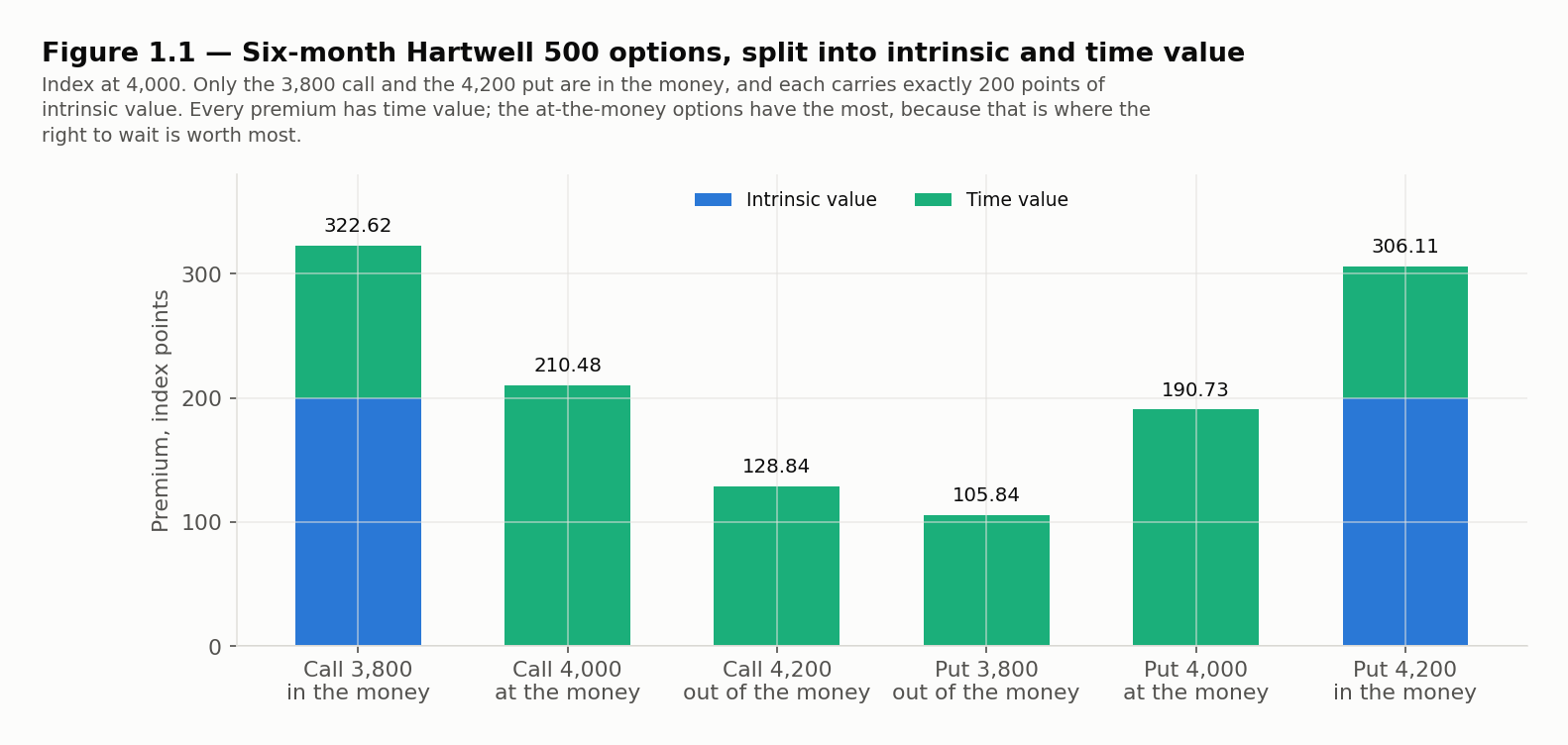
Two things in that table are worth noticing now, because the rest of the chapter explains them.
First, time value is largest at the money. The 4,000 options are pure time value — 210.48 and 190.73 points — while the in-the-money options carry less (122.62 and 106.11) despite their higher premiums. An at-the-money option's outcome is most uncertain, and uncertainty is what time value pays for.
Second, the 4,000 call costs more than the 4,000 put, although both are at the money. The difference is 19.75 points. §1.8 shows that this gap is not a matter of opinion: it is fixed by the forward price of the index, to within the rounding of the quotes.
Moneyness ignores the premium
An in-the-money option is not a profitable option. The 3,800 call is 200 points in the money, but its holder paid 322.62 for it, so at today's index level the position is 122.62 points down. Moneyness describes the exercise decision; profit requires the premium too. The exam uses the two ideas side by side and expects you to keep them apart.
1.2 Payoffs and Profit on an Options Position
The payoff is what a position is worth at expiration. The profit is the payoff less what was paid for it (or plus what was received). With the underlying's price at expiration:
| Position | Payoff at expiration | Profit | Maximum gain | Maximum loss |
|---|---|---|---|---|
| Long call | payoff | Unlimited | The premium | |
| Short call | payoff | The premium | Unlimited | |
| Long put | payoff | , if the asset becomes worthless | The premium | |
| Short put | payoff | The premium |
The convention in this reading, and on the exam unless a question says otherwise, is to subtract the premium as paid, without interest on it for the life of the option. §1.10 carries the premium forward at the risk-free rate, because there the comparison is between two hedges with different cash flows today.
Worked Problem — Profit on Four Positions at Three Index Levels
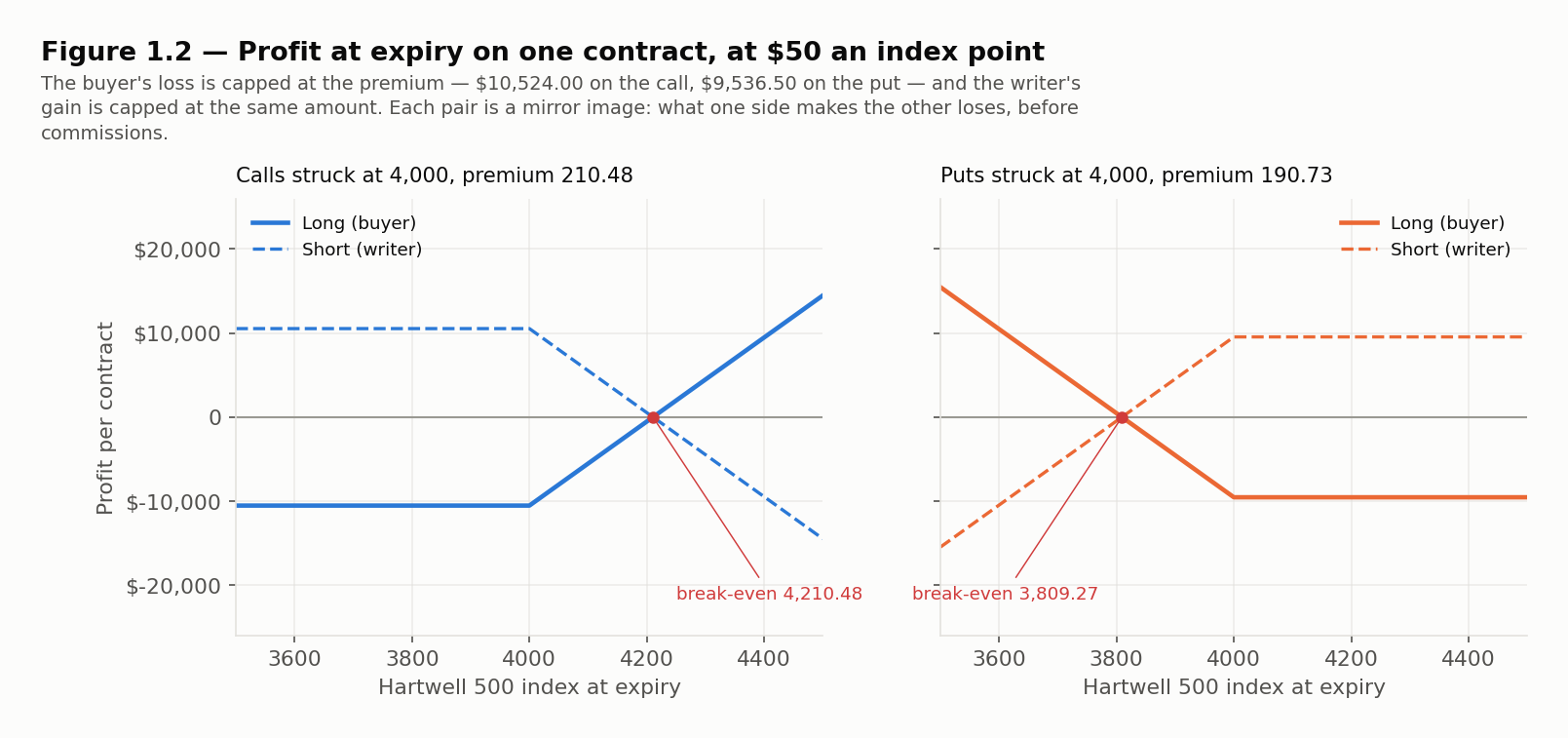
Problem. The six-month 4,000-strike Hartwell 500 call trades at 210.48 and the put at 190.73, with a multiplier of $50. Compute the break-even index level for a buyer of each, and the profit per contract to the buyer and the writer of each at expiration index levels of 3,600, 4,000 and 4,400.
Solution.
Step 1 — break-evens. The call buyer needs the index to rise far enough above the strike to recover the premium; the put buyer needs it to fall far enough below.
Step 2 — the premium per contract.
Step 3 — the long call. Below the strike the call expires worthless and the buyer loses the whole premium. At 4,400 it pays 400 points:
Step 4 — the long put. At 3,600 it pays 400 points:
At 4,000 and above it expires worthless, and the loss is the premium.
Step 5 — the writers. Each writer's profit is the buyer's with the sign reversed.
| Index at expiry | Long call | Short call | Long put | Short put |
|---|---|---|---|---|
| 3,600 | −$10,524.00 | +$10,524.00 | +$10,463.50 | −$10,463.50 |
| 4,000 | −$10,524.00 | +$10,524.00 | −$9,536.50 | +$9,536.50 |
| 4,400 | +$9,476.00 | −$9,476.00 | −$9,536.50 | +$9,536.50 |
BA II Plus keystrokes: Option Profit per Contract — K 4,000; call 210.48; put 190.73; multiplier $50
| Keys | Display | Note |
|---|---|---|
| 4000 + 210.48 = | → 4,210.48 | call break-even |
| 4000 - 190.73 = | → 3,809.27 | put break-even |
| 4400 - 4000 - 210.48 = × 50 = | → 9,476.00 | long call profit at 4,400 |
| 4000 - 3600 - 190.73 = × 50 = | → 10,463.50 | long put profit at 3,600 |
| 190.73 × 50 = | → 9,536.50 | most a put buyer can lose: the premium |
Validation: profit on four option positions
mult, strike = 50, 4000
call_prem, put_prem = 210.48, 190.73

print(f"break-evens: call {strike + call_prem:,.2f}   put {strike - put_prem:,.2f}")
for s_t in (3600, 4000, 4400):
    long_call = (max(s_t - strike, 0) - call_prem) * mult
    long_put = (max(strike - s_t, 0) - put_prem) * mult
    print(f"S_T {s_t:,}: long call {long_call:>11,.2f}   short call {-long_call:>11,.2f}"
          f"   long put {long_put:>11,.2f}   short put {-long_put:>11,.2f}")
# Output:
# break-evens: call 4,210.48   put 3,809.27
# S_T 3,600: long call  -10,524.00   short call   10,524.00   long put   10,463.50   short put  -10,463.50
# S_T 4,000: long call  -10,524.00   short call   10,524.00   long put   -9,536.50   short put    9,536.50
# S_T 4,400: long call    9,476.00   short call   -9,476.00   long put   -9,536.50   short put    9,536.50
Options Are a Zero-Sum Transfer of Risk
Every row of that table sums to zero across the buyer and the writer. An option creates no wealth; it moves a specific slice of an asset's outcomes from one party to another, for a price.
What moves is asymmetric. The put buyer hands over the premium and receives the whole of the index's downside below the strike. The put writer collects the premium and accepts that downside. Whether that is a good trade depends entirely on whether the premium is a fair price for the slice — which is the question the rest of this course keeps asking about products where the option is less visible than it is here.
1.3 How Exchange-Traded Options Work
Specifications
An exchange standardises every term except the price, so that options with the same terms are interchangeable and a position can be closed by trading against anyone.
- Contract size. A stock option is on 100 shares. An index option is on the index level times a dollar multiplier — $50 for the Hartwell 500 in this course; $100 is common for real broad-market indices.
- Expiration. Standard monthly options expire on the third Friday of the expiry month, on a fixed cycle of months. Exchanges also list weekly options with a few days to run, and long-term equity anticipation securities (LEAPS) with expirations up to about three years away.
- Strikes. Listed at fixed intervals around the current price — narrower for low-priced shares, wider for high-priced ones. New strikes are added when the price moves outside the existing range.
- Class and series. All options of one type (calls or puts) on one underlying form an option class. All options of a class with the same strike and expiration form an option series — the unit that actually trades.
- Position and exercise limits. The maximum number of contracts one investor may hold on one side of the market, and the maximum that may be exercised within five consecutive business days. They exist to stop one trader cornering a market through options.
- FLEX options. Exchange-traded options whose strike, expiration and exercise style the parties negotiate, retaining the exchange's clearing guarantee. They are the exchanges' answer to the over-the-counter market.
Trading characteristics
Exchange-traded options are quoted by market makers, who must post a bid and an offer on demand, within a maximum spread the exchange sets. That obligation is what makes the market liquid, and the spread is what market makers are paid for providing it.
Most option positions are closed out rather than exercised. An investor who bought a call closes it by selling a call of the same series — an offsetting order. If the counterparty to that trade is opening a new position, open interest — the number of contracts outstanding — is unchanged; if both sides are closing, it falls.
Two practical features matter for anyone trading them in size. Liquidity is concentrated in near-the-money, short-dated series, and bid-ask spreads on deep out-of-the-money options can be a large fraction of the premium. And because quoted prices are small numbers per share or per index point, a spread of a few cents is a material cost in percentage terms.
Commissions
Brokers typically charge a fixed amount per trade plus a percentage of the trade's value, with a minimum and a maximum.
Worked Problem — Commission on an Option Purchase
Problem. Calderon Securities shares trade at $58.00. An investor buys eight call contracts at $3.20 per share. The broker charges $20 plus 0.75% of the trade's value. Compute the commission and express it as a share of the amount invested.
Solution.
Step 1 — the trade's value. Eight contracts on 100 shares each:
Step 2 — the commission.
Step 3 — as a share of the premium.
Closing the position costs a second commission of the same kind, so a round trip costs roughly 3% of the premium before the share price has moved at all.
Why holders sell rather than exercise
Exercising an in-the-money call triggers a commission on the option and a commission on buying the shares, and selling the shares afterwards costs a third. Selling the option costs one commission. Exercise also throws away any time value left in the premium, which §1.9 shows is never zero for a call on a non-dividend-paying share before expiry. For both reasons, most option positions are closed by an offsetting trade, and exercise is concentrated at expiration.
Margin
Buying an option requires no margin in the usual sense: the buyer pays the premium in full, because the most the buyer can lose is the premium. (Under US rules, options with less than nine months to expiry cannot be bought on margin at all, while longer-dated options can be bought with up to 25% of the premium borrowed.)
Writing an option is different. The writer has an open-ended obligation, so the broker requires collateral. If the writer owns the underlying shares against a written call — a covered call — the shares are the collateral and no further margin is required. If not, the option is naked, and the minimum initial margin is the greater of two tests.
For a naked call:
For a naked put:
Each test is per share; multiply by the number of shares under the contracts. The 20% in test 1 becomes 15% for broad-based index options. The amount by which the option is out of the money is subtracted because that cushion must be used up before the writer loses anything. The premium received can be applied towards the requirement.
Worked Problem — Margin on Three Naked Option Positions
Problem. Calderon Securities trades at $58.00. Compute the initial margin for (a) writing four naked call contracts struck at $62 for $3.20, and (b) writing five naked put contracts struck at $55 for $1.90. Then (c) compute the margin on one naked Hartwell 500 put struck at 3,800 sold for 105.84, with the index at 4,000 and a $50 multiplier.
Solution.
(a) The call is $4 out of the money.
The requirement is the larger, $10.80 a share, on 400 shares: $4,320. The $1,280 of premium counts towards it, so the writer deposits a further $3,040.
(b) The put is $3 out of the money.
$10.50 a share on 500 shares: $5,250.
(c) A broad-based index option uses 15%, and the put is 200 points out of the money.
505.84 points at $50: $25,292 a contract.
BA II Plus keystrokes: Naked Call Margin — Share 58.00; write 4 calls, K 62, premium 3.20
| Keys | Display | Note |
|---|---|---|
| 0.2 × 58 = | → 11.60 | 20% of the share price |
| + 3.2 - 4 = | → 10.80 | test 1: add premium, less the $4 out of the money |
| 0.1 × 58 + 3.2 = | → 9.00 | test 2 |
| 10.8 × 400 = | → 4,320 | the larger test, on 400 shares |
Validation: margin on naked option positions
def naked_call_margin(premium, share, strike, pct=0.20):
    test_1 = premium + pct * share - max(strike - share, 0)
    test_2 = premium + 0.10 * share
    return max(test_1, test_2), test_1, test_2

def naked_put_margin(premium, share, strike, pct=0.20):
    test_1 = premium + pct * share - max(share - strike, 0)
    test_2 = premium + 0.10 * strike
    return max(test_1, test_2), test_1, test_2

m, t1, t2 = naked_call_margin(3.20, 58.00, 62.00)
print(f"Calderon 62 call:  tests {t1:.2f} / {t2:.2f} -> {m:.2f} a share, ${m * 400:,.2f} on 4 contracts")
m, t1, t2 = naked_put_margin(1.90, 58.00, 55.00)
print(f"Calderon 55 put:   tests {t1:.2f} / {t2:.2f} -> {m:.2f} a share, ${m * 500:,.2f} on 5 contracts")
m, t1, t2 = naked_put_margin(105.84, 4000.00, 3800.00, pct=0.15)
print(f"Hartwell 3,800 put: tests {t1:.2f} / {t2:.2f} -> {m:.2f} a point, ${m * 50:,.2f} a contract")
# Output:
# Calderon 62 call:  tests 10.80 / 9.00 -> 10.80 a share, $4,320.00 on 4 contracts
# Calderon 55 put:   tests 10.50 / 7.40 -> 10.50 a share, $5,250.00 on 5 contracts
# Hartwell 3,800 put: tests 505.84 / 485.84 -> 505.84 a point, $25,292.00 a contract
The margin is recalculated daily as the share price moves, and the writer receives a margin call if the account falls below the maintenance requirement — the same mechanism Chapter 4 of the previous course described for futures, applied to only one side of the trade.
Exercise and assignment
Every exchange-traded option is cleared through a clearing house — in the United States, the Options Clearing Corporation (OCC) — which becomes the buyer to every writer and the writer to every buyer, and guarantees performance. Exercise runs through it in four steps:
- The holder instructs their broker to exercise.
- The broker notifies the clearing firm that carries the account, which notifies the OCC.
- The OCC assigns the exercise to a clearing member with an outstanding short position in that series, chosen at random.
- That member assigns it to one of its customers who has written the option, by a method it has disclosed — random selection or first-in-first-out.
The writer chosen must then deliver the shares (for a call) or buy them (for a put) at the strike. A writer cannot choose whether to be assigned, which is why an American option writer carries the risk of early assignment at any time. At expiration, options that are in the money by more than a small threshold are exercised automatically unless the holder instructs otherwise. Index options are settled in cash for the difference between the index and the strike, times the multiplier.
1.4 Dividends and Stock Splits
An exchange-traded stock option is not adjusted for ordinary cash dividends. The market knows the dividends are coming, and they are already reflected in the premium: a call is worth less on a share that will pay dividends before expiry, because the share price falls on each ex-dividend date. (A cash dividend that is unusually large — commonly more than 10% of the share price — may lead the exchange to adjust the terms.)
Stock splits and stock dividends are adjusted for, because they change the number of shares without changing the value of the company. Without an adjustment, a 2-for-1 split would halve the share price and wipe out most of every call's value overnight, with no economic event to justify it.
The rule for an -for- split — new shares for every old ones:
The strike times the number of shares — the total cash payable on exercise — is unchanged. A stock dividend is treated as a split: a 5% stock dividend gives 105 shares for every 100, a 105-for-100 split.
Worked Problem — Adjusting an Option for Splits and a Stock Dividend
Problem. An investor holds one call contract on Calderon Securities, struck at $60 on 100 shares. Compute the adjusted terms after (a) a 2-for-1 split, (b) a 3-for-2 split, (c) a 1-for-4 reverse split, and (d) a 5% stock dividend.
Solution.
| Event | -for- | New strike | New shares | Strike × shares |
|---|---|---|---|---|
| (a) 2-for-1 split | 2-for-1 | $6,000 | ||
| (b) 3-for-2 split | 3-for-2 | $6,000 | ||
| (c) 1-for-4 reverse split | 1-for-4 | $6,000 | ||
| (d) 5% stock dividend | 105-for-100 | $6,000 |
In every case the holder's right is the same right: to buy the same fraction of the same company for the same total of $6,000.
BA II Plus keystrokes: A 5% Stock Dividend — Call on 100 shares, strike 60; 5% stock dividend
| Keys | Display | Note |
|---|---|---|
| 60 ÷ 1.05 = | → 57.1429 | adjusted strike |
| 100 × 1.05 = | → 105 | adjusted shares per contract |
| 57.1429 × 105 = | → 6,000.00 | total exercise cost unchanged |
The exam's favourite trap here
The adjustment changes both the strike and the number of shares, in opposite directions, by the same factor. An answer that changes only the strike, or that moves both the same way, is the distractor. The quickest check is the product: strike times shares must equal what it was before.
1.5 Warrants, Convertible Bonds and Employee Stock Options
Three instruments behave like call options on a company's shares but are not exchange-traded options. What separates them is who writes them: the company itself. When an exchange-traded call is exercised, existing shares change hands between investors. When one of these is exercised, the company issues new shares, and that dilutes every existing shareholder.
Warrants
Warrant A call option issued by a company on its own shares, usually attached to a bond issue to make it more attractive, and often traded separately afterwards. On exercise the company issues new shares at the strike price.
Because exercise creates shares, a warrant is worth less than an otherwise identical exchange-traded call. If a company has shares outstanding and issues warrants, each giving the right to one new share, the warrant's value is approximately
with the regular call valued on the company's share price.
Worked Problem — The Dilution Discount on a Warrant
Problem. A company has 10 million shares outstanding and issues 2 million warrants, each exercisable into one new share. A regular call with the same strike and expiry would be worth $6.00. Estimate the warrant's value and the share of the company the warrant holders would own after exercise.
Solution.
After exercise the warrant holders own of the company. The $1.00 discount per warrant is the cost of that dilution, borne by the warrant holders themselves: they pay the strike into a company whose value is then shared among more shares.
When dilution hits the share price
Dilution is not a surprise on exercise day. In an efficient market the share price reflects the warrants outstanding as soon as they are announced, so existing shareholders bear any cost — if the company sold the warrants for less than they were worth — at announcement, not at exercise.
Convertible bonds
Convertible bond A bond that the holder may exchange for a fixed number of the issuer's shares — the conversion ratio — at certain times during its life. It is a straight bond plus a call option on the issuer's shares, written by the issuer.
Worked Problem — Conversion Value
Problem. A $1,000 bond issued by Calderon Securities is convertible into 15 shares. Compute the conversion price, and the conversion value when the share trades at $58.00 and at $70.00.
Solution.
At $58.00 the conversion option is out of the money: the holder would rather keep a bond than receive $870 of shares. At $70.00 it is in the money. The bond can never be worth less than the larger of its value as a straight bond and its conversion value, and it normally trades above both, because the conversion right still has time value.
Most convertibles are also callable by the issuer. When the share price is high, the issuer calls the bond; the holder, offered the call price in cash or the larger conversion value in shares, converts. This is a forced conversion, and it means a callable convertible carries two options pointing in opposite directions: the holder's call on the shares and the issuer's call on the bond. Chapter 4 prices the issuer's call on its own.
Employee stock options
Employee stock option (ESO) A call option on a company's shares granted to an employee as compensation. It is usually granted at the money, cannot be exercised during a vesting period of several years, cannot be sold or transferred, and is typically forfeited if the employee leaves before it vests.
ESOs differ from exchange-traded options in ways that matter for their value and for the incentives they create:
- They cannot be sold. The only way an employee can turn an ESO into cash is to exercise it and sell the shares. ESOs are therefore often exercised early, which throws away time value — §1.9 shows exactly why that is costly — and means an ESO is worth less to its holder than an equivalent tradable option.
- They dilute. Like warrants, exercised ESOs are usually satisfied by issuing new shares.
- They are an expense. From 2005–06, under both international and US accounting standards, companies must expense ESOs at their fair value on the grant date. Before that, an at-the-money grant could be reported as costing nothing, which partly explains how widely they were used.
- They shape behaviour. Because an option rewards upside and does not penalise downside below the strike, ESOs can encourage executives to take on risk and to manage the share price towards vesting and exercise dates. Backdating — recording a grant as made on an earlier date when the share price was lower, so that the option was in fact granted in the money — was the subject of a wave of investigations in the mid-2000s.
One thing all three have in common
In each case the company is the writer of the option, and the people it sold or granted it to are the holders. That is the pattern this course will keep finding in less obvious places: a bond that contains an option, where the question that decides its price is who holds that option and whether anyone priced it.
1.6 The Six Factors That Move an Option's Price
Six inputs determine a stock option's price. The direction of each is examinable, and each follows from the payoff.
| Factor increases | European call | European put | American call | American put |
|---|---|---|---|---|
| Current price | + | − | + | − |
| Strike | − | + | − | + |
| Time to expiration | ? | ? | + | + |
| Volatility | + | + | + | + |
| Risk-free rate | + | − | + | − |
| Dividends (or yield ) | − | + | − | + |
Price and strike. A call pays , so a higher share price or a lower strike makes it more valuable; a put is the reverse.
Time. An American option with longer to run has every exercise opportunity of a shorter one, and more, so it is worth at least as much. A European option has no such guarantee: a long-dated European call on a share that pays a large dividend between two expiry dates may be worth less than a short-dated one expiring before the dividend. Hence the question marks, although in most practical cases longer European options are worth more too.
Volatility. Higher volatility makes extreme outcomes more likely in both directions. The option holder gains from the favourable extreme and is protected from the unfavourable one by the right not to exercise, so both calls and puts gain. This is the factor that distinguishes options from the underlying: a shareholder is indifferent to volatility as such, and an option holder is not.
The interest rate. A higher rate lowers the present value of the strike the call holder will pay, raising the call; and lowers the present value of the strike the put holder will receive, lowering the put. (Holding the share price fixed. In practice rates and share prices tend to move in opposite directions, and the combined effect can differ.)
Dividends. The share price falls by roughly the dividend on the ex-dividend date. That hurts a call holder and helps a put holder, since neither receives the dividend.
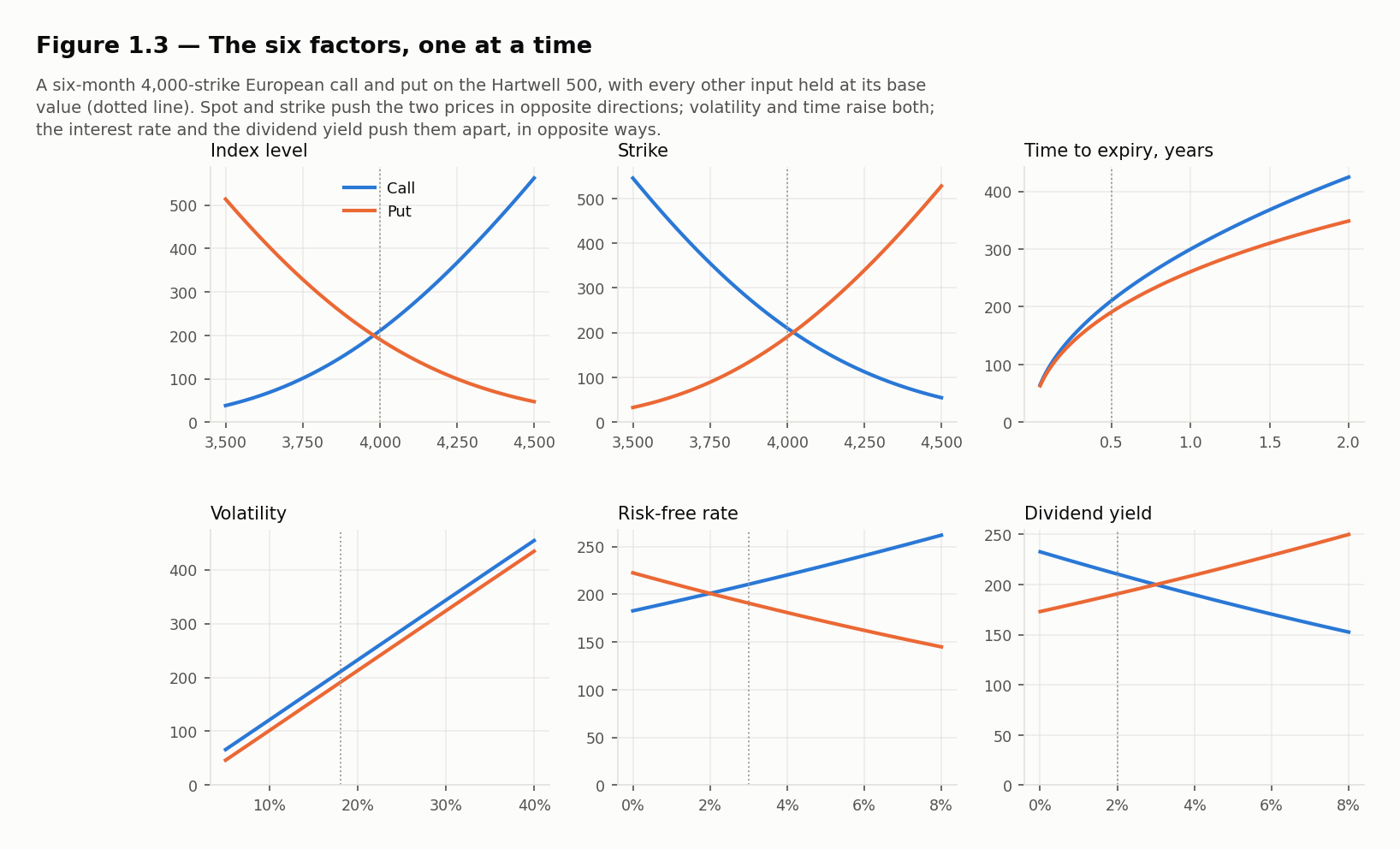
Here is the six-month 4,000-strike Hartwell 500 pair, with one factor moved at a time and everything else held at its base value:
| Change | Call | Change in call | Put | Change in put |
|---|---|---|---|---|
| Base | 210.48 | — | 190.73 | — |
| Index 4,000 → 4,200 | 332.41 | +121.93 | 114.64 | −76.08 |
| Strike 4,000 → 4,200 | 128.84 | −81.64 | 306.11 | +115.38 |
| Time 0.5 → 1.0 years | 299.71 | +89.23 | 260.70 | +69.97 |
| Volatility 18% → 24% | 277.12 | +66.64 | 257.37 | +66.64 |
| Rate 3% → 5% | 230.32 | +19.84 | 171.36 | −19.37 |
| Dividend yield 2% → 4% | 189.78 | −20.70 | 209.43 | +18.70 |
Why volatility moves the call and the put by exactly the same amount
In the table, raising volatility from 18% to 24% adds 66.64 points to the call and 66.64 points to the put. That is not a coincidence of these numbers. §1.8 shows that the call price minus the put price depends only on the index, the strike, the rate, the dividend yield and time — and not on volatility. So whatever volatility does to one, it must do equally to the other. Put-call parity is a statement about the factors as well as about prices.
1.7 Upper and Lower Bounds
Without any model of how prices move, arbitrage alone confines an option's price to a band. The notation, used for the rest of the chapter:
| Symbol | Meaning |
|---|---|
| , | European call and put prices |
| , | American call and put prices |
| Underlying price today | |
| Strike | |
| Time to expiration, in years | |
| Risk-free rate, continuously compounded | |
| Present value of dividends paid during the option's life |
Upper bounds
A call gives the right to buy one share. It can never be worth more than the share itself — otherwise sell the call, buy the share, and pocket the difference:
A put gives the right to receive . An American put can never be worth more than . A European put pays at most at expiration, so today it can never be worth more than the present value of :
Lower bound on a European call, no dividends
Compare two portfolios:
- Portfolio A: one European call plus cash of , invested at the risk-free rate.
- Portfolio B: one share.
At expiration the cash has grown to . If , the call is exercised and A is worth ; if not, the call expires and A is worth . So A is worth , which is never less than B's . A portfolio that is always worth at least as much as another must cost at least as much today:
The zero is there because an option can never have a negative price.
Lower bound on a European put, no dividends
The same logic with a put and a share (Portfolio C) against cash (Portfolio D):
With dividends
A dividend lowers the share price the option holder will face, and the holder does not receive it. Replace by :
For an index with a continuous dividend yield , the equivalent replacement is — in the lower bounds and in the call's upper bound, which tightens from to — the number of index units you would need to hold today, reinvesting the dividends, to have exactly one unit at expiration.
Worked Problem — Bounds on Calderon Options, and the Arbitrage Below One
Problem. Calderon Securities trades at $58.00. The risk-free rate is 3.00% continuously compounded and the options expire in six months. Compute (a) the lower bound on a European call struck at $55 and on a European put struck at $62, assuming no dividends; (b) the same bounds if Calderon pays a $1.00 dividend in three months; and (c) the arbitrage available, with no dividend, if the 55 call is quoted at $3.00.
Solution.
Step 1 — present values.
(a) No dividends.
(b) With the $1.00 dividend. The dividend lowers the call's bound and raises the put's, each by its present value:
(The put bound is 4.0695 from the unrounded factors; the four-decimal terms shown add to 4.0694.)
(c) The call at $3.00 is below its bound of $3.8188. The call is cheap relative to the share, so buy the call and sell the share short:
- Short one share: receive $58.00.
- Buy the call: pay $3.00.
- Invest the remaining $55.00 at 3.00% for six months: it grows to .
At expiration, if , exercise the call, pay $55 for the share and return it to close the short: profit . If , let the call lapse and buy the share in the market for less than $55: the profit is larger still. The minimum profit is $0.8312 a share, whose present value, 0.8188, is exactly the shortfall below the bound.
BA II Plus keystrokes: Lower Bounds With a Dividend — S 58.00; K 55 (call), 62 (put); r 3.00% continuous; T 0.5; dividend 1.00 at 0.25
| Keys | Display | Note |
|---|---|---|
| 0.015 +/- 2nd eˣ | → 0.985112 | discount factor for six months |
| STO 1 | ||
| 55 × RCL 1 = | → 54.1812 | PV of the call strike |
| 0.0075 +/- 2nd eˣ | → 0.992528 | PV of the dividend, per $1 |
| STO 2 | ||
| 58 - RCL 2 - 54.1812 = | → 2.8263 | call lower bound with the dividend |
| 62 × RCL 1 + RCL 2 - 58 = | → 4.0695 | put lower bound with the dividend |
Validation: lower bounds and the arbitrage below one
from math import exp

r, t = 0.03, 0.5
share, div_pv = 58.00, 1.00 * exp(-0.03 * 0.25)

print(f"PV of K: 55 -> {55 * exp(-r * t):.4f}   62 -> {62 * exp(-r * t):.4f}   PV(div) {div_pv:.4f}")
print(f"call K55 lower bound: no dividend {share - 55 * exp(-r * t):.4f}   "
      f"with dividend {share - div_pv - 55 * exp(-r * t):.4f}")
print(f"put  K62 lower bound: no dividend {62 * exp(-r * t) - share:.4f}   "
      f"with dividend {62 * exp(-r * t) - share + div_pv:.4f}")

# The arbitrage against a call quoted at 3.00, below its 3.8188 bound
invested = share - 3.00
print(f"short share, buy call: invest {invested:.2f}, worth {invested * exp(r * t):.4f} at expiry; "
      f"locked-in minimum profit {invested * exp(r * t) - 55:.4f}")
# Output:
# PV of K: 55 -> 54.1812   62 -> 61.0769   PV(div) 0.9925
# call K55 lower bound: no dividend 3.8188   with dividend 2.8263
# put  K62 lower bound: no dividend 3.0769   with dividend 4.0695
# short share, buy call: invest 55.00, worth 55.8312 at expiry; locked-in minimum profit 0.8312
The Hartwell 500 quotes all sit comfortably inside their bounds, with the index adjusted for its dividend yield ():
| Strike | Call bounds | Call quote | Put bounds | Put quote |
|---|---|---|---|---|
| 3,800 | 216.7740 to 3,960.1993 | 322.62 | 0 to 3,743.4254 | 105.84 |
| 4,000 | 19.7516 to 3,960.1993 | 210.48 | 0 to 3,940.4478 | 190.73 |
| 4,200 | 0 to 3,960.1993 | 128.84 | 177.2708 to 4,137.4701 | 306.11 |
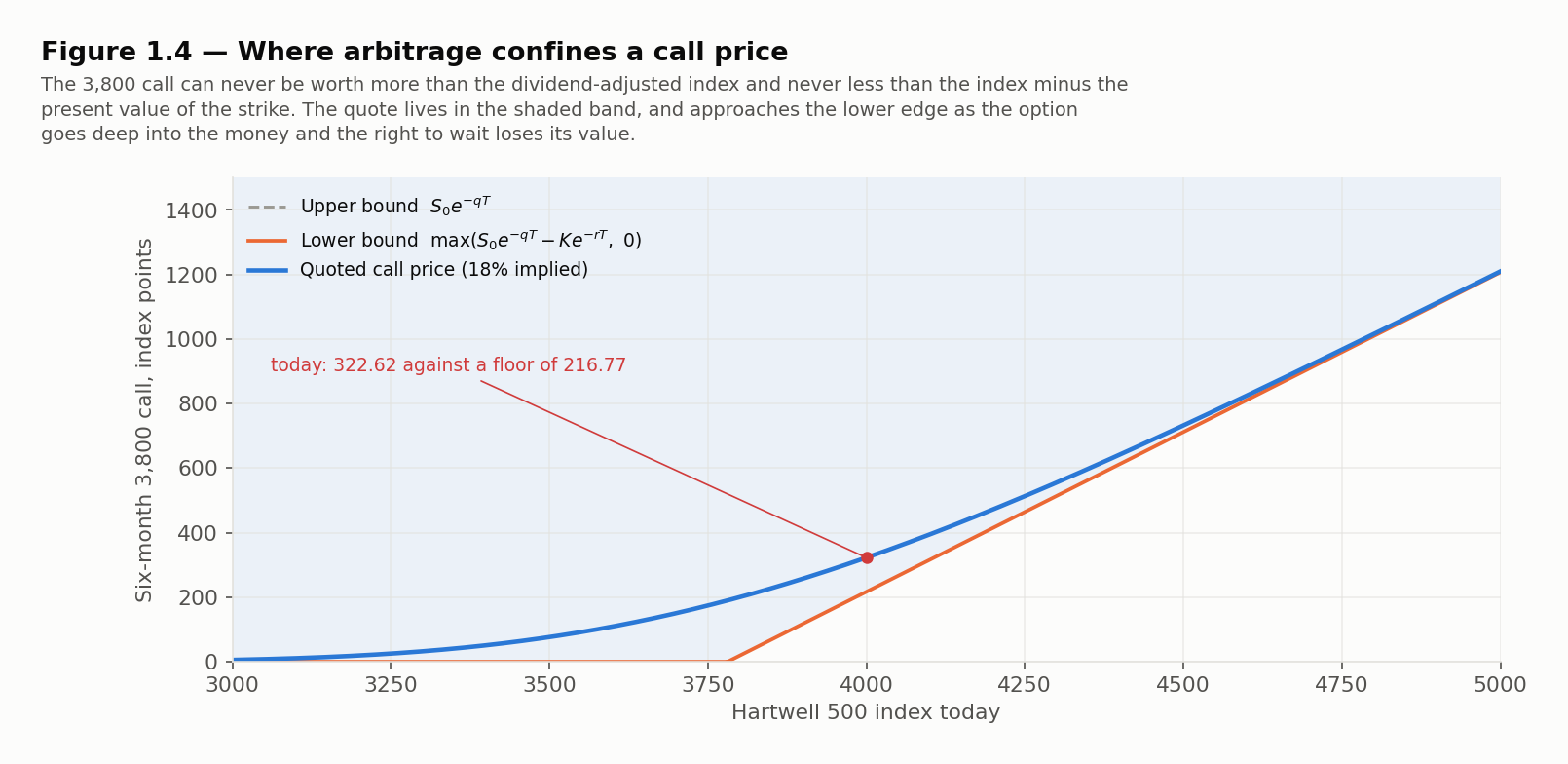
What the bounds do and do not tell you
The upper bounds are very loose — no one would pay 3,960 points for a call on a 4,000 index — and exist mainly to rule out nonsense. The lower bounds are tight for deep in-the-money options and say nothing useful for out-of-the-money ones, where the bound is zero. Between the bounds, the price depends on how volatile the underlying is expected to be, and no arbitrage argument can pin that down. That is where a model takes over.
1.8 Put-Call Parity
The bounds confine one option at a time. Put-call parity links a call and a put with the same strike and expiry, and pins the difference between them exactly.
European options on a non-dividend-paying share
Return to the portfolios of §1.7:
- Portfolio A: one European call plus in cash. At expiration it is worth .
- Portfolio C: one European put plus one share. At expiration: if , the put lapses and C is worth ; if , the put is exercised and C is worth . So C is also worth .
Two portfolios with identical payoffs in every state, and no possibility of early exercise, must cost the same today:
With dividends, or a dividend yield
The share in Portfolio C now also pays dividends, which the holder of A does not receive. Adding cash equal to their present value to Portfolio A restores the equality:
For an index with a continuous yield , hold units in Portfolio C and reinvest the dividends, so that it holds exactly one unit at expiration:
In terms of the forward price
The previous course showed that the forward price of an asset with yield is , so . Substituting:
This is the version to remember, because it says what parity means. A long call plus a short put, both struck at , pays at expiration whatever happens: if the index ends above you exercise the call, and if below, the put is exercised against you. Either way you buy the index at . A long call and a short put together are a long forward contract with delivery price — and a forward struck at when the market forward is is worth .
Three things follow immediately:
- If , then . A call and a put struck at the forward cost the same.
- If , the call is dearer than the put; if , the put is dearer.
- The difference does not depend on volatility, which is why §1.6 found the vega of the call and the put to be identical.
Worked Problem — Checking Parity, and Trading Against a Violation
Problem. The Hartwell 500 is at 4,000.00, with a dividend yield of 2.00% and a risk-free rate of 3.00%, both continuously compounded. Six-month calls and puts are quoted at 322.62 and 105.84 (strike 3,800), 210.48 and 190.73 (4,000), and 128.84 and 306.11 (4,200). (a) Check each pair against put-call parity. (b) A dealer offers the 4,000 put at 150.00, with the 4,000 call still at 210.48. Construct the arbitrage and compute the profit per contract at a $50 multiplier.
Solution.
Step 1 — the forward price.
Step 2 — (a) parity for each strike. With :
| Strike | quoted | |
|---|---|---|
| 3,800 | ||
| 4,000 | ||
| 4,200 |
Every pair agrees to within the rounding of the quotes to the cent. Notice that at the 4,000 strike the call is dearer than the put even though both are at the money in spot terms, because 4,000 is below the forward of 4,020.05. They are not at the money in forward terms, and parity prices the forward.
Step 3 — (b) the synthetic put. Parity says a put must be worth
The dealer is offering it at 150.00 — 40.7284 points too cheap.
Step 4 — the trade. Buy what is cheap and sell its replica. Buy the put at 150.00, and sell the synthetic put — sell the call, buy the index and borrow the present value of the strike:
- Buy the put: pay 150.00.
- Sell the call: receive 210.48.
- Buy units of the index, reinvesting dividends: pay 3,960.1993.
- Borrow the present value of the strike: receive 3,940.4478.
Net cash today: — the same 40.7284 to within the rounding of the components.
Step 5 — at expiration. The dividends have grown the holding to exactly one unit of the index. The long put and the short call together oblige you to sell that unit for whatever the index does, and the 4,000 repays the loan. Every position closes at zero.
BA II Plus keystrokes: The Synthetic Put — Index 4,000; q 2.00%, r 3.00% continuous; T 0.5; 4,000 call 210.48; put offered at 150.00
| Keys | Display | Note |
|---|---|---|
| 0.03 - 0.02 = × 0.5 = 2nd eˣ × 4000 = | → 4,020.0501 | six-month forward |
| - 4000 = | → 20.0501 | F minus K |
| × 0.015 +/- 2nd eˣ = | → 19.7516 | PV: what C minus P must be |
| +/- + 210.48 = | → 190.7284 | parity value of the put |
| - 150 = | → 40.7284 | mispricing, index points |
| × 50 = | → 2,036.42 | arbitrage profit per contract |
Validation: put-call parity on the Hartwell 500 quotes
from math import exp

s0, q, r, t, mult = 4000.00, 0.02, 0.03, 0.5, 50
fwd = s0 * exp((r - q) * t)
calls = {3800: 322.62, 4000: 210.48, 4200: 128.84}
puts = {3800: 105.84, 4000: 190.73, 4200: 306.11}

print(f"F(6m) = {fwd:.4f}")
for k in calls:
    print(f"K {k:,}: C - P = {calls[k] - puts[k]:8.2f}   (F - K)e^-rT = {(fwd - k) * exp(-r * t):9.4f}")

synthetic_put = calls[4000] - (fwd - 4000) * exp(-r * t)
print(f"synthetic 4,000 put {synthetic_put:.4f} against a quote of 150.00: "
      f"{synthetic_put - 150:.4f} points, ${(synthetic_put - 150) * mult:,.2f} a contract")
# Output:
# F(6m) = 4020.0501
# K 3,800: C - P =   216.78   (F - K)e^-rT =  216.7740
# K 4,000: C - P =    19.75   (F - K)e^-rT =   19.7516
# K 4,200: C - P =  -177.27   (F - K)e^-rT = -177.2708
# synthetic 4,000 put 190.7284 against a quote of 150.00: 40.7284 points, $2,036.42 a contract
Parity for a single share
The same relationship on Calderon Securities, which pays no dividend: a six-month European call struck at $60 trades at $3.10, with the share at $58.00 and the rate at 3.00%. The put must be worth
BA II Plus keystrokes: Parity on a Single Share — c 3.10; K 60; S 58.00; r 3.00%; T 0.5
| Keys | Display | Note |
|---|---|---|
| 60 × 0.015 +/- 2nd eˣ = | → 59.1067 | present value of the strike |
| + 3.1 - 58 = | → 4.2067 | the put parity requires |
American options: an inequality, not an equation
Parity relies on neither option being exercised early. American options can be, so for them parity weakens to a pair of bounds. With no dividends:
With dividends of present value , the lower bound falls by :
Worked Problem — Bounding an American Call From Its Put
Problem. An American put on Calderon Securities, struck at $60 with six months to run, trades at $4.30. The share is at $58.00 and the rate is 3.00%. Find the range for the American call with the same terms, (a) if no dividend is expected, and (b) if a dividend with present value $0.9925 is expected.
Solution.
(a) The bounds on the difference:
so , which gives
The $3.10 European call of the previous paragraph sits inside this range, as it must: with no dividend, an American call on Calderon is worth exactly the European one.
(b) The lower bound falls by the dividend: , so
BA II Plus keystrokes: American Parity Bounds — S 58.00; K 60; r 3.00%; T 0.5; American put 4.30
| Keys | Display | Note |
|---|---|---|
| 60 × 0.015 +/- 2nd eˣ = | → 59.1067 | PV of the strike |
| +/- + 58 = | → -1.1067 | upper bound on C minus P |
| + 4.3 = | → 3.1933 | highest possible call price |
| 58 - 60 + 4.3 = | → 2.3000 | lowest possible call price, no dividend |
1.9 Early Exercise
An American option costs at least as much as its European twin, because it carries every right the European does and one more. The question is whether that extra right — to exercise early — is ever worth using.
A call on a non-dividend-paying share: never
The lower bound from §1.7 does the work. For a call on a share that pays no dividends,
The right-hand side is what you get by exercising now. The option is always worth more alive than exercised, so it should never be exercised early. Two separate reasons sit behind the strict inequality:
- Insurance. A holder who waits keeps the right not to buy if the price falls below . Exercising converts a call — which cannot lose more than its premium — into a share, which can.
- The time value of money. Exercising early pays now rather than at expiration. Paying later is better, by the interest on .
What if the holder believes the share is overpriced and wants out? Exercising is still wrong: sell the option instead, collecting its full value, intrinsic plus time. And if the holder wants to keep the option but lock in the gain, shorting the share does that without giving up the time value. An immediate consequence is that an American call on a non-dividend-paying share is worth exactly the same as a European one, .
A call on a dividend-paying share: possibly, just before an ex-dividend date
A dividend changes the trade-off. On the ex-dividend date the share price drops by roughly the dividend, and the call holder receives none of it. Exercising just before the share goes ex-dividend captures the dividend and gives up the interest on for the remaining life of the option. So early exercise can only be optimal immediately before an ex-dividend date, and only if the dividend is larger than the interest saved by waiting:
where is the ex-dividend date. If the dividend is smaller than that, early exercise is never optimal at that date. If it is larger, early exercise may be optimal — the condition is necessary, not sufficient, because the holder also gives up the insurance value of the option.
Worked Problem — Is Early Exercise of a Call Ever Worth Considering?
Problem. An American call on Calderon Securities is struck at $55. The share will go ex-dividend for $1.00 three months before the option expires. The risk-free rate is 3.00%. (a) Could early exercise be optimal immediately before the ex-dividend date? (b) What if the ex-dividend date were one month before expiry?
Solution.
(a) The interest the holder would lose by paying $55 three months early:
The $1.00 dividend exceeds $0.4110, so early exercise just before the ex-dividend date may be optimal. Whether it is depends on how much insurance value the option still carries, which requires a pricing model.
(b) With one month to run after the ex-dividend date:
The dividend now exceeds the interest by more, so the case for exercising is stronger — the less time is left, the less interest and the less insurance the holder gives up.
BA II Plus keystrokes: The Early-Exercise Test for a Call — K 55; r 3.00%; three months, then one month, from the ex-dividend date to expiry
| Keys | Display | Note |
|---|---|---|
| 1 - 0.0075 +/- 2nd eˣ = × 55 = | → 0.4110 | interest given up over three months |
| 1 - 0.0025 +/- 2nd eˣ = × 55 = | → 0.1373 | over one month: 0.03 / 12 = 0.0025 |
A put: sometimes, when it is deep in the money
The interest argument runs the other way for a put. Exercising a put receives now rather than later, so early exercise earns interest — and if the put is far enough in the money, that interest is worth more than anything waiting can add.
The extreme case makes it clear. If the share price falls to zero, the put will pay exactly whenever it is exercised, and the price cannot fall further. Waiting can only lose the interest on , so the holder should exercise immediately. The same is true somewhat above zero.
Worked Problem — When Early Exercise of a Put Strictly Dominates
Problem. An American put on Calderon Securities is struck at $60 with six months to run, and the rate is 3.00%. Following a profit warning the share has collapsed to $0.50. Show that immediate exercise beats waiting, whatever happens to the share, and find the highest share price at which that is guaranteed.
Solution.
Step 1 — exercise now and invest the proceeds.
Step 2 — the best that waiting can do. A put can never pay more than its strike, and does so only if the share is worthless. So waiting yields at most $60.00.
Step 3 — compare. $60.3992 for certain against at most $60.00: exercise now.
Step 4 — the threshold. Exercise is guaranteed to win when the proceeds invested reach at least by expiration, , which gives
Below $0.8933 the American put should be exercised whatever anyone believes about the share. Above it, early exercise may still be optimal, but proving it requires a model.
BA II Plus keystrokes: Early Exercise of a Deep In-the-Money Put — K 60; S 0.50; r 3.00% continuous; six months to expiry
| Keys | Display | Note |
|---|---|---|
| 60 - 0.5 = | → 59.50 | exercise proceeds today |
| × 0.015 2nd eˣ = | → 60.3992 | invested to expiry: beats the 60 maximum from waiting |
| 1 - 0.015 +/- 2nd eˣ = × 60 = | → 0.8933 | share price below which exercise always wins |
Summary of the rationale for early exercise
| Reason to exercise early | Reason to wait | Verdict | |
|---|---|---|---|
| American call, no dividends | None | Insurance; interest on | Never optimal; |
| American call, with dividends | Capture a dividend just before the share goes ex | Insurance; interest on | Possible only just before an ex-dividend date, and only if |
| American put | Interest earned on received early | Insurance against a rebound | Can be optimal when deep in the money; more likely when rates are high |
| American put, with dividends | As above | As above, plus the coming fall in the share price on the ex-date | Dividends make early exercise less attractive, because the holder gains by waiting for the drop |
Employee stock options, revisited
An ESO holder who needs cash has no option but to exercise, because the option cannot be sold. For a call on a non-dividend-paying share, that means taking the exercise value of and giving up the time value that a tradable option would have let them sell. That lost time value is a real cost to the employee, and it is one reason ESOs are valued below otherwise identical exchange-traded calls.
1.10 Putting It All Together: Insuring the Core Equity Fund
Ravensmoor's investment committee asked for downside protection on the $800 million Core Equity Fund, with the upside kept. The tools are now in hand.
Step 1 — how many puts. Why this step: the fund does not move one-for-one with the index; with a beta of 1.15, it moves 1.15% for each 1% move in the market. The count of index puts must therefore cover 1.15 times the fund's value in index terms, which is the beta-weighted count from the previous course:
This is the same 4,600 the previous course computed for the futures hedge before tailing. The tailing adjustment that cut the futures count to 4,589 does not apply here: it existed because a futures contract is worth its futures price and is settled daily, whereas a put pays on the index level once, at expiry.
Step 2 — what it costs. Why this step: the premium is the price of keeping the upside. With 4,600 contracts of $50 a point, each point of premium costs $230,000:
| Strike | Premium | Cost | Share of the fund |
|---|---|---|---|
| 3,800 | 105.84 | $24,343,200 | 3.04% |
| 4,000 | 190.73 | $43,867,900 | 5.48% |
The committee chooses the 3,800 strike, which protects against index falls of more than 5%.
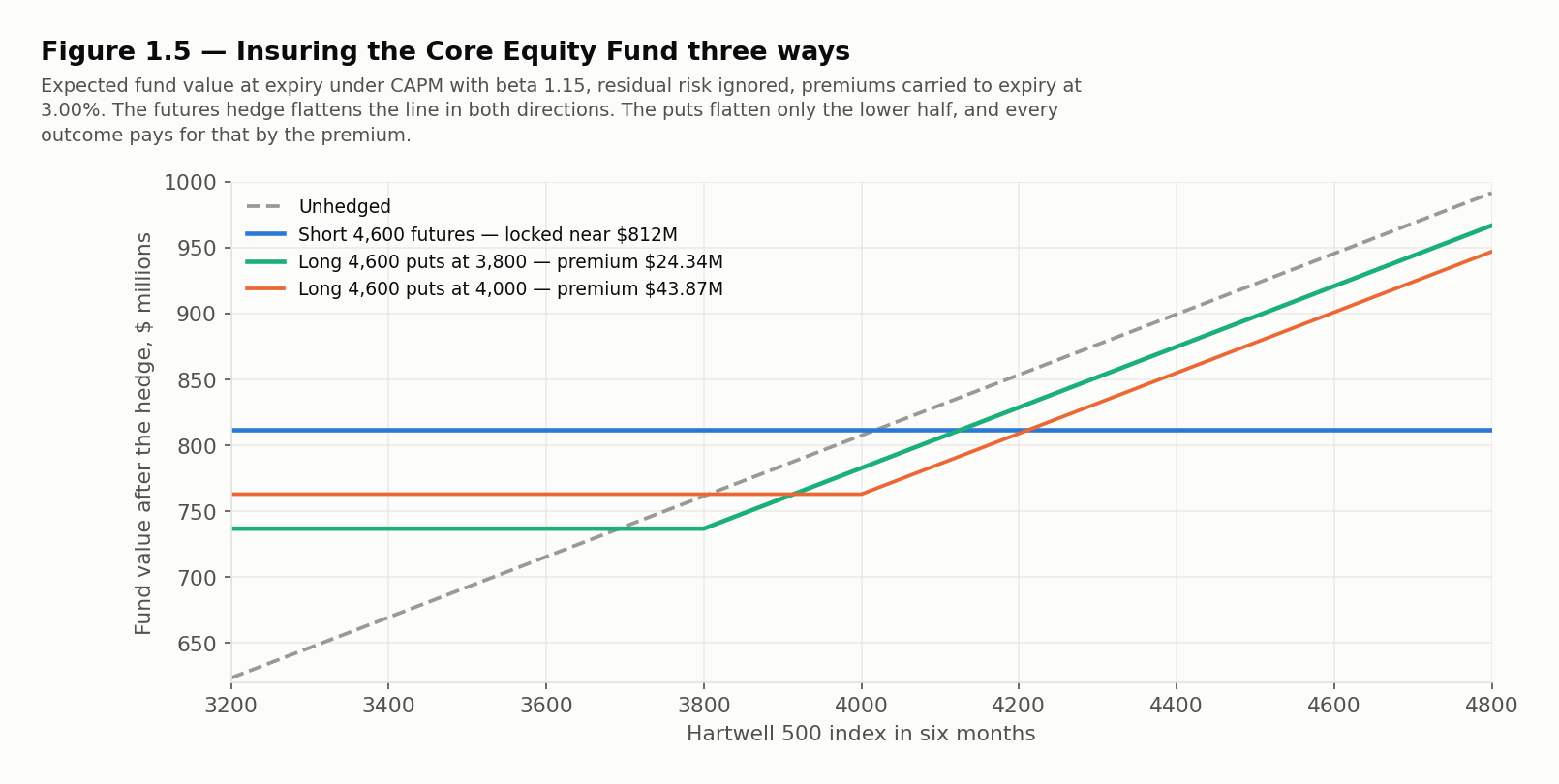
Step 3 — what each hedge delivers. Why this step: the two hedges differ in what they deliver, not just in what they cost, so compare fund values at expiry. Use the capital asset pricing model to translate an index level into an expected fund value, as the previous course did, and ignore the fund's residual risk — the 5.1417% of volatility that no index instrument can remove. Carry the premium forward at the risk-free rate, to $24.71 million, so that every figure is measured on the same date. Each index point moves the fund by dollars, which is $230,000 — exactly what each point of the put position pays.
| Index in six months | Unhedged | Futures hedge | 3,800 puts |
|---|---|---|---|
| 3,400 | $669.40M | $812.01M | $736.69M |
| 3,800 | $761.40M | $812.01M | $736.69M |
| 4,000 | $807.40M | $812.01M | $782.69M |
| 4,400 | $899.40M | $812.01M | $874.69M |
The futures hedge turns the fund into a Treasury bill: $812.01 million whatever the market does — the risk-free return on $800 million. The puts put a floor under the fund at $736.69 million, the expected value at 3,800 less the premium, and below 3,800 the fund's losses and the puts' gains offset point for point. Above the floor, the fund keeps every point of the upside, less the premium. The puts beat the futures hedge if the index finishes above about 4,127.
Step 4 — what parity says about the difference. Why this step: §1.8 showed that a long put is a long call plus a short forward struck at the same price. So the put hedge must be the futures hedge plus a call — and the difference between the two columns of the table above must be exactly the profit on 4,600 calls struck at 3,800, bought at 322.62 and carried to expiry.
Validation: the fund insured with futures, with puts, and the difference
from math import exp

s0, q, r, t, mult = 4000.00, 0.02, 0.03, 0.5, 50
fund, beta = 800e6, 1.15
fwd = s0 * exp((r - q) * t)
n = beta * fund / (s0 * mult)
put_3800, call_3800 = 105.84, 322.62
premium = n * mult * put_3800

def fund_at(s_t):
    """CAPM-expected fund value in six months, residual risk ignored."""
    index_return = s_t / s0 - 1 + q * t
    return fund * (1 + r * t + beta * (index_return - r * t))

print(f"contracts {n:,.0f}; put premium ${premium:,.2f} = {premium / fund:.4%} of the fund")
for s_t in (3400, 3800, 4000, 4400):
    plain = fund_at(s_t)
    futures = plain + n * mult * (fwd - s_t)
    insured = plain + n * mult * max(3800 - s_t, 0) - premium * exp(r * t)
    calls_pnl = n * mult * (max(s_t - 3800, 0) - call_3800 * exp(r * t))
    print(f"S_T {s_t:,}: unhedged {plain / 1e6:7.2f}M  futures {futures / 1e6:7.2f}M  "
          f"puts {insured / 1e6:7.2f}M  | puts - futures {(insured - futures) / 1e6:7.2f}M"
          f"  = calls {calls_pnl / 1e6:7.2f}M")
# Output:
# contracts 4,600; put premium $24,343,200.00 = 3.0429% of the fund
# S_T 3,400: unhedged  669.40M  futures  812.01M  puts  736.69M  | puts - futures  -75.32M  = calls  -75.32M
# S_T 3,800: unhedged  761.40M  futures  812.01M  puts  736.69M  | puts - futures  -75.32M  = calls  -75.32M
# S_T 4,000: unhedged  807.40M  futures  812.01M  puts  782.69M  | puts - futures  -29.32M  = calls  -29.32M
# S_T 4,400: unhedged  899.40M  futures  812.01M  puts  874.69M  | puts - futures   62.68M  = calls   62.68M
The last two columns agree in every scenario. (They differ in the fourth decimal place, about $1,380 in total, because the quoted call and put are each rounded to the cent.)
What the committee bought, and what it paid
The futures hedge was free and the put hedge cost $24.34 million, but that comparison is the wrong one. Parity says the put hedge is the futures hedge with 4,600 calls added. The calls are what restore the upside, and the committee is in effect buying them.
So which hedge is "cheaper" depends on which way the index goes, and nothing else. Below 4,127 the futures hedge ends ahead; above it, the puts do. Neither is mispriced relative to the other — they are related by an identity that holds to within the rounding of the quotes. What the committee chose was not a cheaper hedge but a different exposure: it kept the upside, and the price of keeping it was quoted openly in the market, before the trade, as 105.84 points a contract.
This is the first answer to the question the course keeps asking: who holds the option, and did anyone price it? Here the answer is as clean as it ever gets. Ravensmoor holds the option, and the price is on the screen.
The rest of the course is less clean. In Chapter 2 the options are bundled into strategies and structured products whose pricing is less visible. In Chapters 4 to 7 they are embedded in bonds, mortgages, futures and swaps — and in nearly every case the investor turns out to have written them.
Chapter Summary
What You Learned in Chapter 1
- A call is the right to buy and a put the right to sell, at the strike, on (European) or by (American) the expiry date. The buyer pays a premium; the writer takes on the obligation.
- Moneyness compares the underlying with the strike. Intrinsic value is for a call and for a put; the rest of the premium is time value, which is largest at the money. The six-month 4,000 Hartwell 500 call (210.48) and put (190.73) are pure time value.
- Profit is payoff less premium. The 4,000 call breaks even at 4,210.48 and the put at 3,809.27; a buyer's loss is capped at the premium ($10,524.00 and $9,536.50 a contract), while a call writer's loss is unlimited.
- Exchange-traded options are standardised in size, expiry and strike, quoted by market makers, and cleared and guaranteed by a clearing house that assigns exercises to writers at random. Most positions are closed by offsetting trades rather than exercised.
- Buyers pay the premium in full. Naked writers post the larger of premium + 20% of the share price − the out-of-the-money amount, or premium + 10% of the share price (calls) or of the strike (puts) — 15% for broad index options. Four naked Calderon 62 calls at $3.20 require $4,320.
- Options are not adjusted for ordinary cash dividends but are adjusted for splits and stock dividends: an -for- split multiplies the strike by and the shares by , leaving strike × shares unchanged.
- Warrants, convertibles and ESOs are written by the company, so exercise issues new shares and dilutes. A warrant is worth about of an equivalent call — $5.00 against $6.00 when 2 million warrants join 10 million shares.
- Six factors: spot, strike, time, volatility, the risk-free rate and dividends. Volatility raises calls and puts alike; the rate and dividends push them apart in opposite directions.
- Bounds: and ; a Calderon 55 call quoted at $3.00 against a bound of $3.8188 locks in at least $0.8312 a share at expiry.
- Put-call parity: , or in forward form . A long call plus a short put is a forward struck at . A 4,000 put offered at 150.00 against a parity value of 190.7284 is worth $2,036.42 a contract, riskless.
- For American options parity becomes .
- Early exercise: never for a call on a non-dividend-paying share; possibly just before an ex-dividend date if ; and sometimes for a deep in-the-money put, always once — $0.8933 on a $60 strike.
- Insuring the Core Equity Fund takes 4,600 puts — the beta-weighted count — and costs $24.34 million at 3,800. By parity, the put hedge equals the futures hedge plus 4,600 calls, and the two differ in every scenario by exactly the profit on those calls.
What's Next
Chapter 2 builds on parity. Every option strategy — covered calls, protective puts, spreads, straddles, strangles — is a combination of the four positions in §1.2, possibly with the underlying and a bond, and parity prices all of them from the quotes in this chapter. The committee's hedge will be re-engineered there into a zero-cost collar, which pays for the 3,800 floor by selling away the upside above a strike that parity determines. The chapter then turns to exotic options, to products with no visible premium at all, and to the variance swap, which turns the gap between the 18% volatility implied by these quotes and the 15% the index actually realises into a cash flow.
Concept Checks
Fast recall before the exam-format questions — no calculator needed.
-
The Hartwell 500 stands at 4,000. A put option on the index with a strike of 4,200 is:
- out of the money, because the strike is above the current index level and so the put has no intrinsic value
- at the money, because index options are classified against the forward price rather than the spot level
- in the money, because exercising it now would let the holder sell at 4,200 something worth only 4,000
- in the money only if its premium is less than 200 points, since moneyness compares the payoff with the cost
-
An investor writes a call option on a share. If the holder exercises it, the writer must:
- sell the share to the holder at the strike price, whether or not the writer already owns it
- buy the share from the holder at the strike price, paying cash in exchange for the delivered shares
- pay the holder the premium again, since exercise transfers the original premium back to the buyer
- choose between delivering the share and paying the difference in cash, at the writer's discretion
-
A company whose shares underlie exchange-traded options declares its regular quarterly cash dividend. The terms of the options are:
- adjusted by reducing the strike by the amount of the dividend, so that call holders are not disadvantaged by the ex-dividend fall
- adjusted by increasing the number of shares per contract in proportion to the dividend yield
- adjusted only for American options, since European holders cannot exercise before the ex-dividend date
- not adjusted, because ordinary cash dividends are expected and are already reflected in the option premiums
-
Which feature most clearly distinguishes a warrant from an exchange-traded call option on the same company's shares?
- A warrant can only be exercised at expiration, while an exchange-traded call can be exercised at any time
- Exercise of a warrant causes the company to issue new shares, which dilutes the existing shareholders
- A warrant gives the right to sell the shares back to the company, while the call gives the right to buy
- A warrant has no strike price; the holder receives shares in proportion to the company's earnings growth
-
Holding everything else constant, an increase in the volatility of the underlying will change the prices of European calls and puts as follows:
- raise the price of a call and lower the price of a put, because higher volatility raises the expected share price
- lower the price of both, because more volatile assets are riskier and options on them are worth less
- raise both prices, because the holder gains from favourable extremes and is protected from unfavourable ones
- leave both unchanged, because volatility affects the probability of exercise but not the expected payoff
-
The risk-free interest rate rises while the share price, volatility and all other inputs are unchanged. The effect on European options is that:
- both calls and puts become more valuable, since the holder's premium can be invested at a higher return
- calls become more valuable and puts less valuable, because the present value of the strike falls
- calls become less valuable and puts more valuable, because future payoffs are discounted at a higher rate
- neither changes, since the interest rate affects the forward price but not the price of an option
-
An investor who bought 10 call contracts last week closes the position by selling 10 contracts of the same series. The buyer of those contracts is opening a new long position. What happens to open interest?
- It falls by 10, because the investor's position has been closed out
- It rises by 10, because a new long position has been opened by the buyer
- It falls by 20, because both the original long and the original short are closed
- It is unchanged, because the investor's long position simply passes to the new buyer
-
Why is it never optimal to exercise an American call on a non-dividend-paying share before expiration?
- Because the call is worth more alive than exercised: waiting keeps the insurance and defers paying the strike
- Because exercising early incurs commissions on the shares, which always exceed any gain from early exercise
- Because the clearing house prohibits early exercise of calls unless the underlying share pays a dividend before expiry
- Because the share price is expected to rise, so the payoff from exercise will be larger at expiration
-
An American put on a non-dividend-paying share is deep in the money. The main reason early exercise can be optimal is that:
- the put's time value becomes negative once it is in the money, so the holder loses by waiting
- exercising now receives the strike immediately, and the interest earned on it can exceed what waiting could add
- an in-the-money put has more time value than an out-of-the-money one, so it should be cashed in while that value is high
- the writer of the put is required to deliver the share at the strike as soon as it falls below it
-
When a share is expected to pay dividends during an option's life, the lower bounds on European call and put prices are adjusted by:
- adding the present value of the dividends to the share price in both bounds, since dividends raise the share's total return
- subtracting the dividends from the strike price, since the option holder effectively pays a lower price
- using the share price less the present value of the dividends, which lowers the call bound and raises the put bound
- ignoring them, because the bounds are derived from arbitrage and dividends are not an arbitrage cash flow
Exam-Style Practice
Standalone four-option questions at the real exam's pace — 2.4 minutes each.
Chapter 1 — Options Markets and the Properties of Options
-
An investor writes three put contracts, each on 100 shares, with a strike of $45.00, receiving a premium of $2.60 a share. At expiration the share trades at $41.50. Ignoring commissions, what is the investor's profit or loss?
- A profit of $780
- A loss of $270
- A loss of $1,050
- A profit of $270
-
A share trades at $72.00. An investor writes five naked call contracts, each on 100 shares, with a strike of $75.00, at a premium of $2.80 a share. Using the standard rule — the greater of the premium plus 20% of the share price less any out-of-the-money amount, and the premium plus 10% of the share price — what is the initial margin requirement?
- $5,000
- $8,600
- $5,700
- $7,100
-
An investor holds a call contract on 100 shares with a strike of $90. The company announces a 3-for-2 stock split. After the adjustment, the contract gives the right to buy:
- 150 shares at $60.00 a share
- 66.67 shares at $135.00 a share
- 100 shares at $60.00 a share
- 150 shares at $90.00 a share
-
A non-dividend-paying share trades at $50.00. The risk-free rate is 4.00% a year, continuously compounded. What is the lower bound on the price of a nine-month European call struck at $45.00?
- $5.00
- $6.76
- $6.33
- $3.52
-
A share trades at $38.00 and will pay a dividend of $0.80 in two months. The risk-free rate is 5.00% continuously compounded. What is the lower bound on a six-month European put struck at $42.00?
- $2.96
- $4.80
- $2.17
- $3.76
-
A three-month European call on a non-dividend-paying share, struck at $50.00, trades at $4.20. The share price is $52.00 and the risk-free rate is 3.00% continuously compounded. According to put-call parity, the price of the European put with the same strike and expiry is:
- $2.20
- $1.83
- $6.57
- $2.59
-
The one-year forward price of an index is 1,250. A one-year European call on the index struck at 1,200 costs 95.00, and the risk-free rate is 4.00% continuously compounded. What should a one-year European put with the same strike cost?
- 46.96
- 45.00
- 143.04
- 48.04
-
A non-dividend-paying share trades at $46.00. Six-month European options struck at $45.00 are quoted at $3.40 for the call and $1.90 for the put. The risk-free rate is 6.00% continuously compounded. Which strategy exploits the mispricing, and what profit does it lock in at expiration, per share?
- Write the call, buy the put and buy the share, financed by borrowing; profit $0.86 at expiration
- Buy the call, write the put and sell the share short, investing the proceeds; profit $0.83 at expiration
- Buy the call, write the put and sell the share short, investing the proceeds; profit $0.86 at expiration
- Write the call, buy the put and buy the share, financed by borrowing; profit $0.83 at expiration
-
A $1,000 bond is convertible into 25 shares of its issuer. The shares trade at $44.00, and the bond's value as a straight bond, ignoring the conversion right, is $960. What is the lowest value at which the convertible should trade?
- $960, its value as a straight bond, since a bond can never be worth less than that
- $2,060, the sum of its straight-bond value and its conversion value
- $1,000, its face value, until the holder actually converts the bond
- $1,100, its conversion value, since that exceeds its value as a straight bond
-
An American call on a share is struck at $80.00. The share will go ex-dividend for $0.75 in two months, and the option expires one month after that. The risk-free rate is 6.00% continuously compounded. Which statement is correct?
- Early exercise immediately before the ex-dividend date may be optimal, because the dividend exceeds the $0.40 of interest lost on the strike
- Early exercise is never optimal, because an American call should never be exercised before expiration, whatever dividends are paid
- Early exercise immediately before the ex-dividend date is certainly optimal, because the dividend exceeds the interest on the strike
- Early exercise may be optimal at any time in the next two months, since the coming dividend steadily reduces the call's value until the ex-date
Get the full course: FRM Level I: Financial Markets and Products II